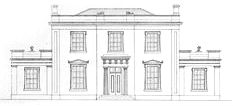
Lord Courtland is a friend that Robert Ferrars mentions as having recently been trying to build a house with plans by Bonomi.
Austenopedia
Showing posts with label The Titled. Show all posts
Showing posts with label The Titled. Show all posts
Lady Metcalf
Lady Metcalf is a friend of Lady Catherine de Bourgh who takes on a Miss Pope as a governess purely based on Lady Catherine's suggestion. Lady Catherine assures her Hunsford audience that Lady Metcalf told her "you have given me a treasure."
Because of Lady Metcalf's honorific, we know that she's married to a Knight or a Baronet, making her of lower noble rank than Lady Catherine though likely still mingling in high society. It is unclear, however, if Lady Metcalf lives in Kent or if Lady Catherine knows her from time spent in London.

Sir William Lucas
Age
This is never stated, though we know he has a daughter in her late 20’s, so he’s likely close to 50, if not older.
Family and Situation
Sir William Lucas is married to Lady Lucas and is the father of Charlotte Lucas, Maria Lucas and at least one son. Based on the fact that Mrs. Bennet is sure he will make an effort to visit Bingley, as well as his generally congenially persona, it’s likely that he is engaged in ensuring his children's welfare.
Sir William seems to be a long-time resident of Hertfordshire, though his elevation to knighthood is quite recent. The narrator tells us “Sir William Lucas had been formerly in trade in Meryton, where he had made a tolerable fortune, and risen to the honour of knighthood by an address to the king during his mayoralty. The distinction had perhaps been felt too strongly. It had given him a disgust to his business, and to his residence in a small market town; and, in quitting them both, he had removed with his family to a house about a mile from Meryton, denominated from that period Lucas Lodge, where he could think with pleasure of his own importance, and, unshackled by business, occupy himself solely in being civil to all the world.” We know that Sir William was later presented at St. James’s Court, suggesting he’s spent at least some time in London. Since Sir William appears to be able to live at Lucas Lodge as a gentleman, he likely either has robust investments or had amassed a significant fortune in his career.
Appearance
Mrs. Bennet says that Sir William is “So much the man of fashion” before making a point in front of Darcy about how polite he is. As Mrs. Bennet’s taste is not generally the most discerning, it is likely that Sir William is not on the cutting edge of fashion, but sets the high water mark in provincial Meryton.
Character
We know that Sir William Lucas is easily impressed by lofty titles and social grandeur; his retirement from trade and frequent references to St. James’s suggests that he really does aspire to the aristocratic lifestyle. When playing cards with Lady Catherine, we’re told “Sir William did not say much. He was storing his memory with anecdotes and noble names.”
On the other side, this seeming pretentiousness does not translate into rudeness. The narrator tells us that “though elated by his rank, it did not render him supercilious; on the contrary, he was all attention to everybody. By nature inoffensive, friendly, and obliging, his presentation at St. James's had made him courteous.” We know that he was once the Mayor of Meryton and even Mrs. Bennet concedes that he’s well-bred, suggesting that he’s generally quite well-liked.
When described from Lizzy’s point-of-view, it is clear that Sir William lacks the intellectual rigor she might prefer. At one point, we’re told “Elizabeth loved absurdities, but she had known Sir William's too long. He could tell her nothing new of the wonders of his presentation and knighthood; and his civilities were worn out, like his information.” At another point, he is described as being “empty-headed” like his younger daughter.
? Fitzwilliam (Eldest Son of the Earl)
Age
Because we are told that Colonel Fitzwilliam is “about thirty”, this man is likely into his thirties. We have no information about other siblings he may have.
Family and Situation
Because we are told more than once that Colonel Fitzwilliam is a younger son, we know he must have an elder brother who is also the son of the Earl of -------. Because of the way noble titles work, it is likely that this eldest son borrows one of his father's lesser titles and is either a Viscount or a Baron (with the former being the higher rank).
The Late Earl of --------
The Late Earl of -------- had a surname of Fitzwilliam and would have been the father of the current Earl, Lady Anne Darcy and Lady Catherine de Bourgh. It is likely that he had more prestige than wealth as his daughters both married into families with large estates but less impressive titles.
Earl of --------
The Earl of ------- is the son of the Late Earl of ------- and the brother of Lady Anne Darcy and Lady Catherine de Bourgh. He never appears in the novel, but we know he is the father of Colonel Fitzwilliam and at least one other son.
Based on the fact that the Earl's sisters Lady Anne and Lady Catherine both married men of lower rank, it is likely that he is not as wealthy as his nephew Fitzwilliam Darcy.
The Fitzwilliam Family
Though seldom on stage, the Fitzwilliam clan is the highest-ranking family in the novel, with connections to virtually every aristocratic character we meet. Presumably they are fairly prestigious, though given that last generation’s daughters seem to have married down the social ladder, it is not unreasonable to assume that the prestige of their title may outweigh their actual financial wealth.
Based on the characters we meet in novel, we can infer the following about the Fitzwilliam family tree:
- The Late Earl of ------- had the following children:
- The Earl of -------, who married an unspecified woman and has at least the following children:
- Lady Catherine Fitzwilliam, who married Sir Lewis de Bourgh and the following children:
- Lady Anne Fitzwilliam, who married Mr. Darcy Senior and had the following children:
It is possible that there are more children of the late Earl, but they do not appear in the novel. We have no information about where the ancestral estate might be; based on the patterns of the time as well as the fact that Fitzwilliam daughters married into families from wide-ranging Derbyshire and Kent, it is likely that the family is well-connected in London society.
Sir Lewis de Bourgh
Family and Situation
Sir Lewis is the deceased husband of Lady Catherine de Bourgh and the father of Anne de Bourgh.
We are told almost nothing about his situation, though we know that married he married the daughter of an earl and was prepared to put up with the antics of a young Lady Catherine Fitzwilliam. His widow later describes his family, like the Darcys, as being “respectable, honourable, and ancient—though untitled”. Given that he likely is just a baronet (since his daughter is untitled), his estate must have brought in significant funds if he was able to attract the daughter of an Earl.
Lady Catherine says at one point that she sees “no occasion” for entailing estates away from the female line as “It was not thought necessary in Sir Lewis de Bourgh's family.” This is likely meant to imply that no ancestor was worried about his children wastefully spending through the estate. On the other hand, it could also mean that the estate has not been very large for very long and no one has actually had an opportunity to set up an entail.
Rt. Hon. Lady Catherine de Bourgh
Age
We are never told Lady Catherine’s age per se, but she’s almost certainly a generation older than Fitzwilliam Darcy and Col Fitzwilliam, putting her in her 40s or 50s.
Family and Situation
Born Lady Catherine Fitzwilliam, she is the daughter of The Late Earl of ------ and the sister of the current Earl. She was also the sister of the late Lady Anne Darcy. Lady Catherine is now the widow of Sir Lewis de Bourgh and the mother of Anne de Bourgh. Though Lady Catherine likely brought some money with her into her marriage, the fact that she married down the ladder (presumably to a baronet), suggests that her family was elite but not especially rich.
Lady Catherine also seems quite keen on her nephews Fitzwilliam Darcy and Col. Fitzwilliam. With they are in residence, Lady Catherine “was, in fact, almost engrossed by her nephews, speaking to them, especially to Darcy, much more than to any other person in the room.” Lady Catherine never mentions Georgiana Darcy or Col. Fitzwilliam's elder brother or other siblings, so this fixation may be limited to her plans for Darcy as a future spouse to Anne.
Lady Catherine leads us to believe that there is considerable wealth tied up in Rosings Park, the family home, and that it has never been “entailed away from the female line.” How much income she currently has as a widow, however, is somewhat unclear. It is entirely possible that she continues at Rosings on the legal largess of her daughter, though it does not seem especially likely. Though we’re told explicitly that Lady Catherine is not the Justice of the Peace in her country, “whenever any of the cottagers were disposed to be quarrelsome, discontented, or too poor, she sallied forth into the village to settle their differences, silence their complaints, and scold them into harmony and plenty.”
Despite the temptation to think of Lady Catherine as always lurking at Rosings Park, we know she has a chaise and four and Elizabeth is told upon arriving in Kent that Lady Catherine “was still in the country,” suggesting that she does occasionally leave it. We do know though that Anne has not been presented at court, so it is unlikely that Lady Catherine is properly participating in The Season.
It does seem that Lady Catherine has patronage over the parish of Hunsford and her minister Mr. Collins is quick to refer to her as “his patroness.” We know that the household has several carriages which she frequently sends over the party at Hunsford parsonage, suggesting that her social circle is somewhat limited. Later on, Mr. Bennet implies that Mr. Darcy “has more to give” as regards the church, though, so her powers may be limited.
Other Connections
Lady Catherine has a symbiotic relationship with her obsequious parson, Mr. Collins. She seems to enjoy his praise and the convenience of being able to have him over to entertain her without having any respect for the man.
She also tells a story of sending a Miss Pope to a Lady Metcalf, who she mentions called on her the prior day, suggesting that they both live somewhere in the neighborhood.
Appearance
When Lizzy first meets her, we’re told “Lady Catherine was a tall, large woman, with strongly-marked features, which might once have been handsome.” Mrs. Bennet describes her as “a very fine-looking woman.”
Character
Oddly, George Wickham gives us one of the most cogent descriptions of Lady Catherine, saying “I have not seen her for many years, but I very well remember that I never liked her, and that her manners were dictatorial and insolent. She has the reputation of being remarkably sensible and clever; but I rather believe she derives part of her abilities from her rank and fortune, part from her authoritative manner, and the rest from the pride for her nephew, who chooses that everyone connected with him should have an understanding of the first class,” however it’s uncertain how much time the son of a steward would really have spent in Lady Catherine’s company. Elizabeth finds these observations to be very much the case; we’re told of Lady Catherine that “Her air was not conciliating, nor was her manner of receiving them such as to make her visitors forget their inferior rank. She was not rendered formidable by silence; but whatever she said was spoken in so authoritative a tone, as marked her self-importance, and brought Mr. Wickham immediately to Elizabeth's mind; and from the observation of the day altogether, she believed Lady Catherine to be exactly what he represented.”
We also know that Lady Catherine loves to give advice. Lizzy observes while at Rosings that Lady Catherine “inquired into Charlotte's domestic concerns familiarly and minutely, gave her a great deal of advice as to the management of them all; told her how everything ought to be regulated in so small a family as hers, and instructed her as to the care of her cows and her poultry.” Lady Catherine also weighs in on how Lizzy and her sisters ought to have been raised, what Lizzy should do to improve her performance on the pianoforte and how she has brokered a number of successful governess-pupil relationships among women of her acquaintance.
Though Lady Catherine often insists she knows more than anyone, we encounter several instances in which that is clearly not the case. She harangues Elizabeth about the scandal of Lydia’s elopement, first saying that she “knows it all” and that talking about how the whole thing was patched up by Mr. Bennet and Mr. Gardiner, suggesting that she does not have the foggiest notion that Darcy was involved. This mis-information, however, does suggest that she is getting gossip from somewhere, even if she is not always in the know about her own family.
The de Bourgh Family of Rosings Park
Unlike some of the other families in the novel, we do not actually have much information about the de Bourgh clan. We know that they live at Rosings Park which is described as a modern building and that the local parson’s land is only a lane away from the estate. Based on these clues, Austen may be trying to tell us that the de Bourghs were not quite so wealthy or established a few generations ago. Alternatively, the new Rosings may be a re-build on the site of an older house.
Members of the de Bourgh family discussed or featured in the novel include:
Though we have no idea what kind of income Rosings Park brings in, we do know that the family has patronage over Hunsford parish, presumably located in the nearest town.
Lady Anne Darcy
Age
Lady Anne is likely of an age with Lady Catherine. We know that she’s deceased by the beginning of the novel. We never receive details on the specifics of her death, but we know it couldn’t have been more than 16 years ago, evidenced by Georgiana’s presence.
Family and Situation
Lady Anne was the daughter of The Late Earl of -----, making her the sister of Lady Catherine de Bourgh and the current Earl of -----. She married Mr. Darcy of Pemberley and was mother of Fitzwilliam Darcy (to whom she leant her maiden name) and Georgiana Darcy. As she married a wealthy commoner, it is possible that Lady Anne either had a name but an insignificant dowry or married for romantic notions of love. Given Darcy’s resistance to imprudent matches, it’s likely that it was the former.
Character
Lady Anne is rarely mentioned by any of the characters in the novel. Lady Catherine asserts that they planned for the eventual union of Fitzwilliam Darcy and Anne de Bourgh, but this information is never confirmed from a second source.
Subscribe to:
Posts (Atom)